Six Types of Poker Players You'll Meet at the Table
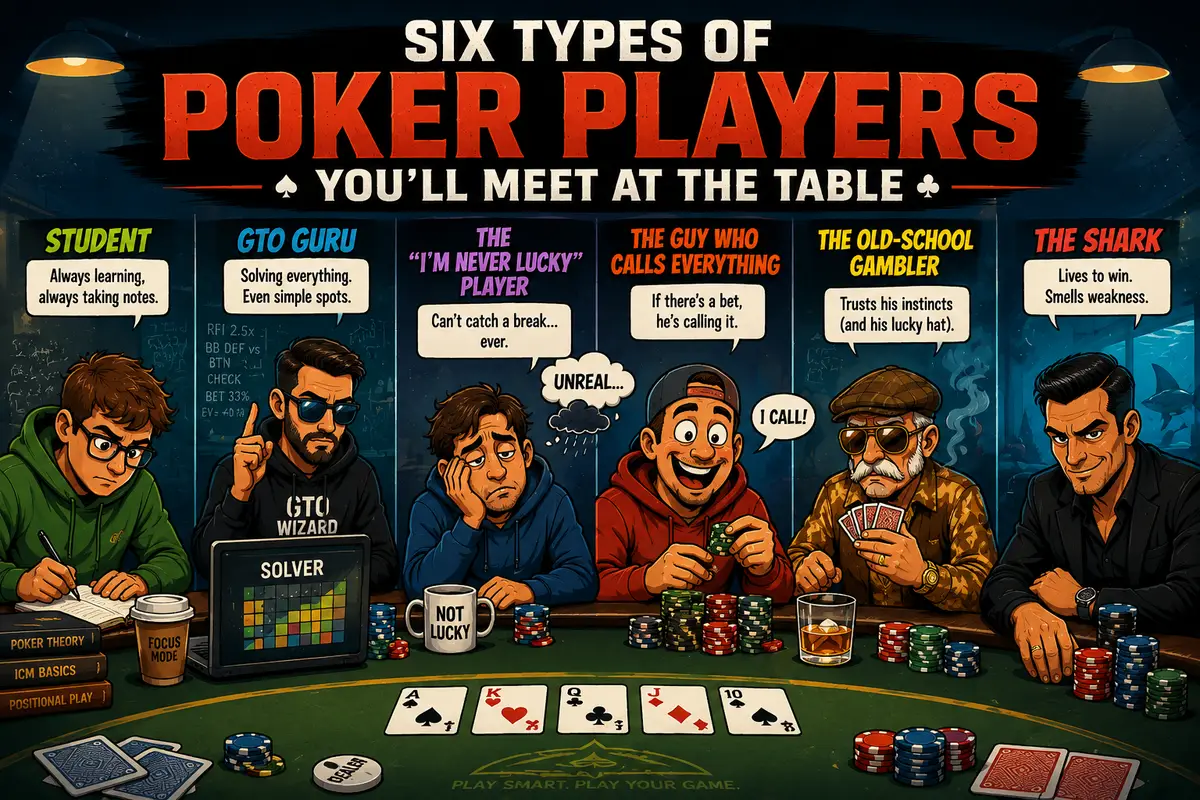
Originally written by OmahaMajstor and published on Pokerasi.com on November 3, 2009. This article has been reworked and updated in a more modern tone, while preserving the spirit, characters and humor of the original.
If you’ve ever sat down at a live poker table, you’ve probably realized pretty quickly that poker isn’t just about the cards.
Poker is about people.
The cards are the same for everyone, but the people sitting around the table can be completely different. There’s the player who wants to analyze every hand, the one who is convinced the deck personally hates him, the guy who simply cannot fold, and the veteran who has been playing cards for so long that he probably doesn’t remember when he started.
And the most interesting part?
You’ll find the same characters everywhere.
Belgrade, London, Budapest, Las Vegas, online games, private home games… the setting changes. The characters don’t.
Of course, nobody fits perfectly into just one category. At some point, most of us have been the Student, gone through an “I’m never lucky” phase, or called a hand we probably shouldn’t have.
But for the purposes of this little piece of poker anthropology, let’s assume there are six basic species sitting around every poker table.
And if you want to know which one you should ultimately become — the answer is at the end.
1. The Student
The Student is the player who has spent more time studying poker than actually playing it.
He knows what equity, pot odds, ranges, ICM, blockers, MDF and at least twenty other abbreviations mean — and he’ll happily explain them to you if you give him enough time.
He watches poker content.
Follows streams.
Reads strategy articles.
Has several tabs open with a solver.
His phone is full of poker videos he’s going to “watch later.”
He probably never will.
But he needs to have them.
The Student believes in mathematics and theory. That, by itself, is not a problem.
The problem begins when he realizes that the people at the table don’t actually play poker the way his charts say they should.
Someone opens J5 offsuit.
The Student raises an eyebrow.
Someone calls a 3-bet with K8 suited.
The Student is already reaching for his forehead.
Someone calls three streets with third pair and hits the river.
At that point, all theoretical discussion comes to an immediate stop.
The Student simply cannot understand how someone can make a play that, according to all his calculations, is terrible.
Even less does he understand why that same person ends up winning the pot.
And then comes the mandatory analysis.
“He should have folded preflop.”
“You can’t call that.”
“His range is way too weak here.”
“That’s negative EV in the long run.”
The Student is often completely right.
He just has one small problem.
He is far too happy to share his knowledge with everyone else.
After every significant hand, he’s ready to explain exactly where his opponent went wrong. After an hour at the table, several players have already received a free poker coaching session.
And that is probably the last thing a good poker player should be doing.
If someone is making a mistake that is making you money, the last thing you should do is explain why they are making that mistake.
The Student hasn’t learned that yet.
But he will.
Usually after a few expensive lessons.
His bankroll is another story.
He arrives at the table responsibly, with a clearly defined number of buy-ins. Losing the first one isn’t pleasant. Losing the second is a personal financial crisis.
The third usually isn’t coming.
Not because he doesn’t have the money.
Because “you have to maintain discipline.”
And whenever he finally builds a decent profit, he suddenly remembers that he has responsibilities tomorrow.
A lecture.
University.
Work.
Training.
Anything.
The more chips he has in front of him, the earlier his obligations seem to start.
Favorite line:
“You simply can’t call that.”
2. The GTO Guru
Back in the day, this player was the Durrr Wannabe — the guy who wanted to be Tom Dwan, play every hand aggressively and turn every table into an episode of High Stakes Poker.
Today, he has evolved.
Now he has a solver.
The GTO Guru is the player who discovered that there is a mathematically correct way to play almost everything.
And now he’s determined to find it.
His poker world consists of ranges, frequencies, sizings, node locking, exploits and endless discussions about whether one particular hand is a better bluff candidate than another.
If you make an unusual play, he won’t simply tell you that you played badly.
He’ll tell you:
“That’s not solver-approved.”
If you ask why, prepare yourself.
You’re getting a fifteen-minute lecture.
The GTO Guru genuinely knows a lot about poker.
The problem is that he sometimes forgets who he is playing against.
Because there is one small difference between a solver and the guy sitting across the table.
A solver doesn’t drink beer.
A solver doesn’t play because he’s bored.
A solver doesn’t have a favorite number.
A solver doesn’t think he’s “due.”
And, most importantly, a solver never says:
“I knew you were bluffing, but I just couldn’t fold.”
The GTO Guru can spend an hour analyzing whether a particular spot is +0.12 or +0.18 EV, while the guy sitting across from him opens 9♣3♣ because he likes the cards.
And that’s where the problem begins.
GTO is an incredible tool.
But live poker isn’t a laboratory.
People aren’t ranges.
They don’t make decisions based purely on mathematics.
And that’s why a player who understands theory perfectly isn’t necessarily the player who will make the most money in a particular live game.
The best players know the theory.
But they also know when to leave it on the shelf.
The GTO Guru is still learning that part.
To his credit, though, he doesn’t always explain the hand immediately anymore.
He just opens the solver.
And checks.
Favorite line:
“That’s pure negative EV.”
3. The “I’m Never Lucky” Player
This player exists everywhere.
Every poker room.
Every limit.
Every table.
He isn’t necessarily a bad player.
That’s important.
Some of these players actually play quite well.
They just have one problem.
The cards hate them.
At least that’s how they see it.
Sit next to this player for ten minutes and you’ll know his entire poker history.
You’ll hear about the time he lost AA against 72.
The time he missed his flush draw.
The time he flopped a set and his opponent hit a runner-runner straight.
The time he had kings and an ace came on the river.
And, of course, you’ll learn that these things happen to him far more often than they happen to anyone else.
His memory works selectively.
He remembers every bad beat.
Every cooler.
Every ridiculous river.
But somehow forgets the twenty times he was the one who hit his one-outer.
“Bro, I never hit.”
Of course he does.
Those hands just don’t count.
Online poker makes things even more interesting.
That’s where the theory gets serious.
The RNG is rigged.
Bots are everywhere.
The algorithm knows when you have AA.
And if you lose three all-ins in a row, there is a very real possibility that the poker room has personally decided to ruin your evening.
The problem isn’t the bad beat.
The problem is taking variance personally.
Every loss becomes evidence.
Every win is simply “finally, something normal.”
And then comes the most dangerous phase.
“It’s fine. I’m due.”
That’s when the chase begins.
A bad call becomes “I have to try.”
A big bluff becomes “now is the perfect spot.”
Another buy-in becomes “I’m getting my money back.”
And from that moment on, you’re no longer playing poker.
You’re playing against your previous result.
That is a very difficult game to win.
Favorite line:
“How is that even possible again?“
4. The Guy Who Calls Everything
This is the player every good poker player secretly wants at the table.
Not because he’s a bad person.
Quite the opposite.
He’s usually great fun.
He just has one serious flaw.
He doesn’t fold.
Ever.
Preflop?
“Let’s see a flop.”
Flop?
“I’ve got something.”
Turn?
“Maybe it comes.”
River?
“Well, now it doesn’t make sense to fold.”
And just like that, a small hand becomes a big pot.
The Guy Who Calls Everything has one universal poker theory:
Anything can come.
And technically, he’s right.
It can.
A gutshot can come.
A backdoor can come.
A runner-runner can come.
A flush can come.
That one perfect card can appear.
And if the cards are suited?
Then there is absolutely no reason to fold.
Because “what if the flush comes?”
His poker philosophy is simple.
If you call, you have a chance.
If you fold, you have no chance.
Mathematics tries to explain that it doesn’t quite work that way.
He doesn’t listen.
He doesn’t know what pot odds are.
But somehow, he always has odds.
He doesn’t know what implied odds are.
But “if I hit, I’m taking the whole thing.”
He doesn’t know what equity is.
But “I’ve still got two cards.”
That’s enough.
The most entertaining part comes when he actually hits.
The table goes silent.
The Student says nothing.
The GTO Guru looks at the ceiling.
The Shark says nothing.
And the Guy Who Calls Everything happily pulls in the chips.
“See? What did I tell you?”
And that brings us to the great irony.
This player often thinks poker is purely a game of luck.
A good player knows that players like him are one of the reasons poker can be profitable in the first place.
That’s why the Shark and the Guy Who Calls Everything often get along so well.
One loves the action.
The other knows how to get paid for it.
And somewhere between them, several buy-ins usually change hands.
Favorite line:
“You never know what can come.”
5. The Old-School Gambler
He was playing cards before most of the people at the table even knew what “online poker” meant.
Poker isn’t his first game.
It probably isn’t even his second.
Rummy.
Preferans.
A card game with rules nobody under 40 understands.
Five-card poker.
Roulette.
Sports betting.
He’s done it all.
And everything has its own theory.
Not the theory you’ll find in a book.
His theory.
You don’t need to convince him that a certain play isn’t optimal.
You don’t need a solver.
You don’t need a HUD.
And you definitely don’t need to explain that his call was -3.7 BB/100.
He’ll simply look at you and say:
“Son, I’ve been playing this game for thirty years.”
And that ends the discussion.
The Old-School Gambler believes in experience, intuition and feel.
If you tell him a particular play isn’t optimal, he’ll probably tell you that poker isn’t played on paper.
And, as usual, there is some truth to that.
Because the Old-School Gambler genuinely sees things that younger players often miss.
He notices nervousness.
He notices when someone wants to leave.
He notices when someone is playing a bigger game than they’re comfortable with.
He notices when someone has had a few more drinks than usual.
He notices when someone suddenly starts talking too much.
He may not know how to define an exploit.
But he knows when the guy across the table is uncomfortable.
Sometimes, that’s enough.
Of course, his biggest enemy is modern poker terminology.
If you tell him:
“I had a BTN open against a BB defend range, then 3-bet to 11 BB, the board was monotone, he’s checking 33% of his range, I have the nut advantage and decided to polarize my sizing…”
The Old-School Gambler will listen.
Take a sip.
Look at you.
And ask:
“So… did you play the hand or not?”
If you try to explain solver strategy, there’s a good chance he’ll respond with a story about a game in 1998 where he had 7-2 and beat a guy holding aces.
That story will last at least twenty minutes.
Maybe forty.
Because the Old-School Gambler has another defining characteristic.
He always has a story.
“So there I was one time…”
And that’s when you know you’re in trouble.
Not because you’re losing the hand.
Because you’re losing time.
Favorite line:
“I’ve been playing this game for thirty years.”
6. The Shark
And then there is the Shark.
The Shark doesn’t have to be the loudest player at the table.
In fact, he’s often the opposite.
While everyone else is arguing about the last hand, the Shark is watching.
While the Student explains what his opponent should have done, the Shark is remembering how that opponent actually plays.
While the GTO Guru is thinking about the optimal sizing, the Shark is thinking about the person sitting across from him.
The Shark knows the theory.
But he knows something even more important.
Poker is played against people.
He knows why he sat in that game.
He knows who he wants to play against.
He knows who is weaker.
He knows who is tilting.
He knows who hates big pots.
He knows who calls too much.
And he knows who should never be bluffed.
The Shark has no need to prove how much he knows to everyone at the table.
He doesn’t explain every hand.
He doesn’t argue with the dealer.
He doesn’t try to convince his opponent that he made a bad call.
If someone makes a terrible call and gets there, the Shark congratulates them.
If someone makes an obvious mistake, the Shark remembers it.
If someone asks how they should have played the hand, he might even help them.
Because the Shark understands one simple thing:
His job isn’t to be the smartest player at the table.
His job is to be the most profitable one.
The Shark also understands that poker is constantly changing.
What was standard ten years ago may be outdated today. Strategies evolve, players study more, tools become more sophisticated, and the line between a good player and a great player keeps moving.
That’s why the Shark never stops learning.
He watches new material.
Reviews hands.
Studies modern strategy.
Works on his mental game.
And, most importantly, he is willing to admit when he doesn’t know something.
His biggest advantage isn’t that he never makes mistakes.
He does.
Everyone does.
The difference is that he doesn’t spend the next hour explaining why he was actually right.
The Shark also knows how to lose.
A bad beat is a bad beat.
A cooler is a cooler.
A bad session is a bad session.
He comes back the next day and plays again.
No drama.
No conspiracy theories.
No “I’m never lucky.”
And that is exactly why the Shark sits at the top of the food chain.
Not because he always gets the best cards.
Because he understands the game.
And the player sitting across from him.
Favorite line:
“Good hand.”
So… Which One Are You?
You probably recognized yourself in at least two of these categories.
Maybe you were the Student.
Maybe you went through your GTO Guru phase, trying to explain a solver-approved line to a guy who doesn’t even know what a solver is.
Maybe you’ve had periods when “the cards just weren’t coming.”
Maybe you’ve called because “you never know what can come.”
Or maybe you’re the Old-School Gambler who has been playing for thirty years and is currently shaking his head at everything you’ve just read.
And that’s perfectly fine.
Because every good poker player has been a little bit of all of these at some point.
The real difference comes when you learn which traits to keep and which ones to leave at the table.
Take the Student’s desire to learn.
Take the GTO Guru’s understanding of theory and discipline.
From the “I’m Never Lucky” player, learn to accept that variance is part of the game.
From the Guy Who Calls Everything, take the courage — but leave the calls.
From the Old-School Gambler, take the experience and ability to read people.
And from the Shark?
Take everything else.
Because the goal isn’t to become a player who never makes mistakes.
The goal is to become a player who understands why he makes them, adapts quickly, and leaves every session a little better than when he sat down.
And if you ever sit at a table surrounded by a Student, a GTO Guru, an “I’m Never Lucky” player, a Guy Who Calls Everything and an Old-School Gambler…
Don’t panic.
You might have just found a very good game.
Just make sure you’re not the guy who calls everything.
Your next big win starts here
Join the action and unlock exclusive promotions, weekly rakeback, and jackpot rewards from your very first hand.